

Patient Perspectives and Public Preferences: Why the Difference Matters
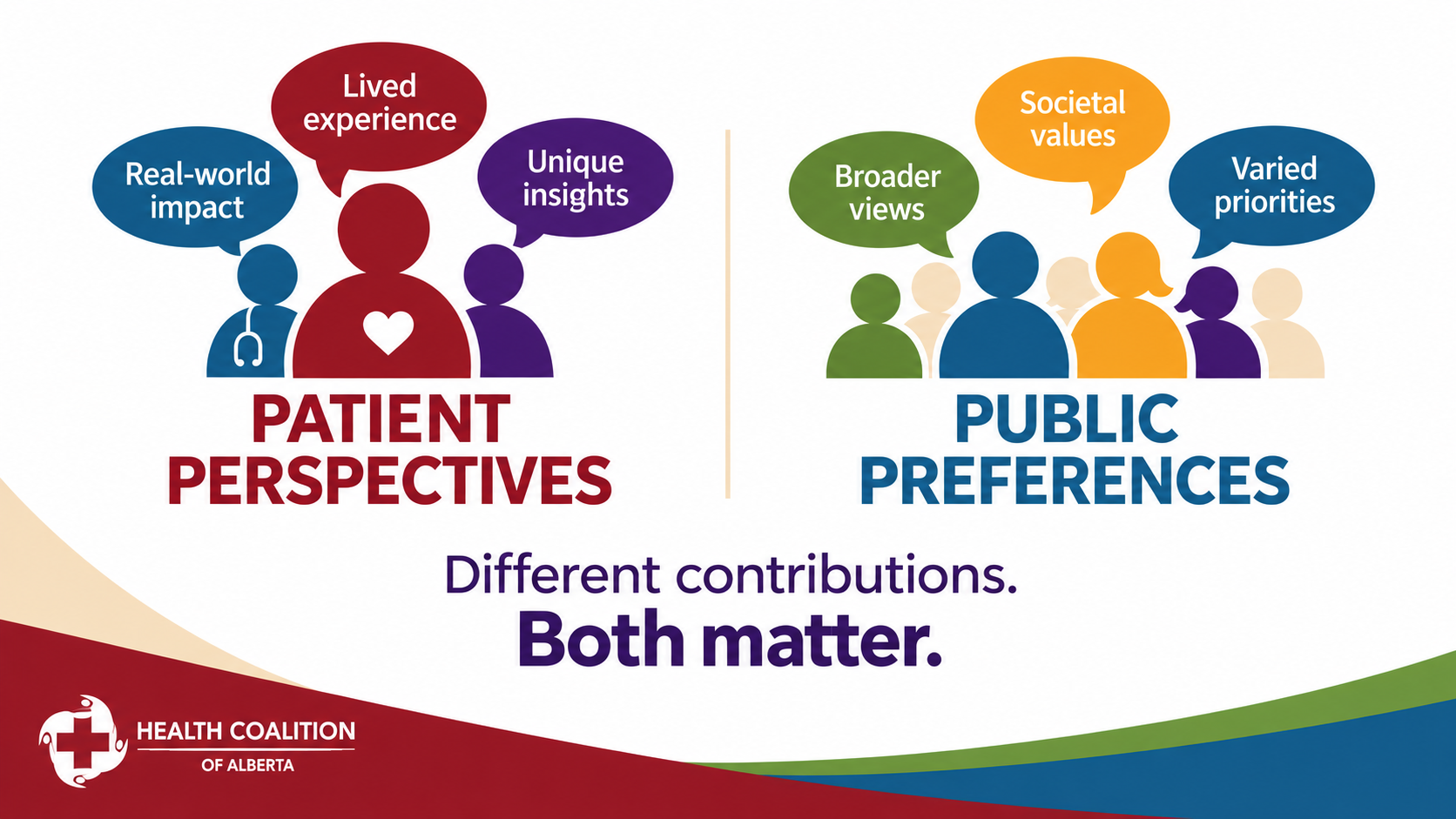
Patients, caregivers and patient organizations have fought hard for a meaningful place at the health care decision-making table. Could we be at risk of losing some of that ground?
Increasingly this year, we have heard public and citizen engagement discussed alongside patient engagement in conversations about health policy, medicines and health care decision-making. On the surface, that may sound like simply broadening the range of perspectives being heard. But there is an important distinction that risks getting lost.
Public perspectives and patient perspectives are not interchangeable. They answer different questions and bring different knowledge to health care decision-making. Hearing from the broader public can add valuable perspectives, but it cannot provide the lived experience and expertise of patients and caregivers directly affected by a condition, treatment or health system decision. As approaches to engagement evolve, we need to be clear about whose perspectives are being sought and for what purpose, and ensure that broader public engagement does not dilute or replace meaningful patient engagement.
Patients and caregivers bring knowledge that the general public cannot. They know what it means to live with a condition and to navigate the health system while doing so. They know what it is like to wait a year or more for a test or specialist appointment, spend hours in an emergency department, struggle to find the right service or provider, or manage care across different parts of the system. They also understand which outcomes matter most, the burden of treatment and disease, and the consequences of having limited or no treatment options. And they may have a very different tolerance for risk or uncertainty, particularly when living with a serious or progressive condition.
The distinction is not simply about labels. Public or citizen engagement seeks perspectives from people as members of the broader population. Patient engagement draws on the lived experience of people directly affected by a condition, treatment or health system decision. Patient lived experience is not universal. It brings knowledge that cannot be assumed or replicated through broader public engagement.
Lived experience is itself a form of expertise, bringing insight to health care decision-making that broader public engagement cannot provide.
The difference can be striking. At a recent conference, a presentation about New Zealand’s medicines system included examples of priorities identified through broader citizen engagement, such as free access to bandages and high-fluoride toothpaste. Those may be entirely legitimate public health priorities. But they illustrate how different the conversation can be from one with patients living with serious illness, who may be focused on access to immunotherapies or other innovative treatments that could extend or significantly improve their lives.
Both perspectives can be valuable, but they serve different purposes. The concern arises when broad public or citizen preferences are used as a proxy for patient perspectives, or when the two are combined in ways that dilute what patients themselves are telling decision-makers.
National pharmacare is one area where this distinction could become particularly important. If Canada continues to develop its approach to pharmacare, there will be choices about which medicines are covered and how priorities are set. For patients living with cancer, rare diseases and other serious or chronic conditions, those priorities may be shaped by very specific needs: access to a treatment that is not currently funded, fewer restrictions on existing coverage, earlier access to new therapies, or greater choice among treatments when people respond differently. Those priorities may look very different from what emerges when the broader public is asked what it values in a national drug program.
Asking Canadians broadly what they value in a public drug program is different from asking patients what they need from that program and what access, or lack of access, to particular treatments means for their health and their lives. One form of engagement cannot simply stand in for the other. We also need to be cautious about assuming that approaches used in other countries can simply be transferred to Canada. Health systems, cultures and expectations around the role of patients in decision-making differ. Canada has spent many years building greater recognition of meaningful patient engagement in health technology assessment and other health policy processes. That progress should continue.
As governments, payers and health organizations explore new ways of involving Canadians in decisions about medicines and health care, we encourage patients, caregivers and patient organizations to pay attention to how patient and public perspectives are being sought, described and used. If the two are being treated as interchangeable, or if broader public engagement is being used in place of direct engagement with patients and caregivers, call it out. Ask whose perspectives are being sought, what questions they are being asked to inform, and whether patients and caregivers have a meaningful opportunity to contribute their own expertise.
Meaningful patient engagement has taken years to build. We should be careful not to let it become diluted just as its value is increasingly being recognized.